
Best risk management strategies to ensure business sustainability
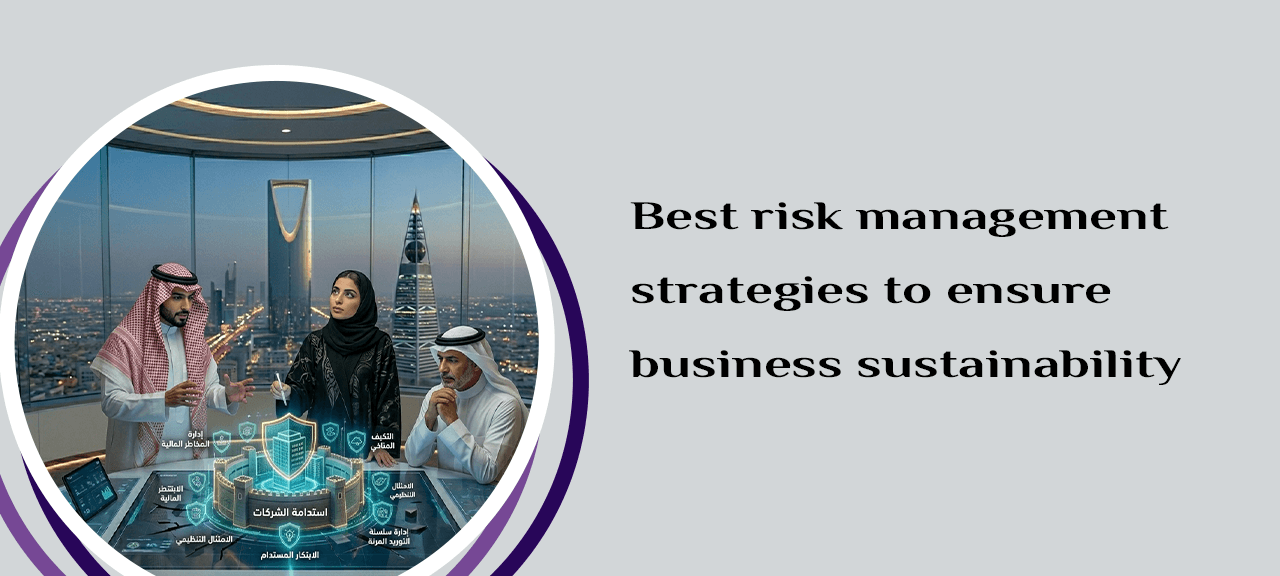
The future of companies depends on adopting Risk Management Strategies!
In today's business world, success is measured by resilience, not just profits. Economic challenges and rapid tech shifts have made Risk Management Strategies a strategic necessity; managed poorly, risks can quickly escalate into crises that threaten an organization's very survival.
What is meant by Risk Management Strategies?

Risk Management Strategies are a continuous process designed to create a safe growth environment through four pillars:
- Risk Identification: Monitoring threats before they materialize.
- Impact Analysis: Measuring potential financial and reputational damage.
- Response Planning: Formulating proactive and well-thought-out strategies.
- Mitigation or Exploitation: Minimizing negative effects or turning challenges into competitive advantages.
In short, risk management is the ability to foresee what others miss and prepare for it. True success lies in embedding Risk Management Strategies into the very core of corporate culture.
Why do some companies fail despite having strong plans?
We often hear about companies at the peak of their success that collapsed while planning global expansion. In the case of one major firm, the team later discovered that failure wasn't due to a weak growth plan, but rather the neglect of "road traps" and core risks such as:
- Market Fluctuations: Sharp shifts in supply and demand.
- Supply Chain Fragility: Dependence on unreliable or interruptible sources.
- Talent Gaps: A lack of competencies capable of leading transformation.
A fundamental truth for every decision-maker: the absence of Risk Management Strategies never means the absence of risk; it simply means leaving your company vulnerable to uncalculated surprises that could end its journey in an instant.
Request a risk assessment for your facility now… with Sa'ee experts.
Best Risk Management Strategies to ensure company sustainability:

To achieve sustainability, institutions must follow precise strategies that guarantee excellence and resilience:
1. Proactive Risk Identification
Early detection is key; you cannot confront an unknown threat. This requires analyzing weaknesses and threats, reviewing historical data to predict patterns, and engaging teams for a comprehensive vision.
- Real-life example: An industrial firm relied on a single supplier; when a logistics crisis hit, production lines stopped completely. The lesson: Don't wait for danger—anticipate it and secure your alternatives now.
2. Risk Analysis and Evaluation
Threats vary in severity. Risk Management Strategies rely on classifying them based on: Impact (on operations and reputation) and Probability of occurrence.
3. Income Diversification
Depending on a single source weakens the organization and leaves it vulnerable to shocks. Diversification minimizes sectoral risks and enhances financial stability.
Examples: Banks diversifying loan portfolios or telecom companies providing cloud services alongside connectivity are models of companies protecting themselves by distributing risks.
4. Building Effective Contingency Plans
In business, the question isn't "if" a risk will occur, but when. Building alternative plans requires:
- Developing Multiple Scenarios: Including best-case, worst-case, and most likely outcomes.
- Defining Clear Procedures: Establishing fast-response protocols for each scenario.
- Regular Team Training: Ensuring full readiness through periodic implementation drills.
5. Investing in Technology
Modern tech is the backbone of Risk Management Strategies, enabling precise analysis of massive data and predicting cyber and financial risks to speed up decision-making.
Example: Financial institutions using AI to detect complex fraud patterns and prevent them before any actual damage occurs.
6. Promoting a Risk-Aware Culture
Risk management isn't just for the compliance department; it's a shared responsibility from junior staff to senior leadership. This is achieved through continuous training and fostering transparency, encouraging employees to report gaps without fear to build a resilient, proactive organization.
7. Continuous Monitoring and Evaluation
Risks evolve and change with time and technology. Therefore, periodic review of strategies and updating contingency plans based on lessons learned from previous mistakes is the only guarantee for the system to remain effective and up-to-date with reality.
The role of leadership in the success of Risk Management Strategies:


True Transformation Starts at the Top: In successful organizations, leadership is the primary driver by:
- Listening and Engaging: Actively addressing field concerns and involving teams in solutions to boost commitment.
- Data-Driven Decisiveness: Making bold decisions based on accurate data rather than guesswork.
- Conscious Leadership: Realizing that total risk avoidance is an illusion, and true success lies in managing risks with intelligence and wisdom.
Risk Management Strategies in different sectors:
The nature of risks varies according to the activity, and this dictates the customization of strategies:
- Industrial Companies: Focus on operational risks such as technical failures and securing supply chains to ensure production flow.
- Banks: Prioritize financial risks, anti-fraud, and strict adherence to regulatory legislation.
- Telecommunications Companies: Focus efforts on cybersecurity, continuity of technical services, and adapting to rapid market changes.
Balance between risks and opportunities:
The goal of risk management is not to paralyze growth with excessive caution, but to find the perfect balance. Every growth opportunity carries risk, and every risk managed intelligently can unlock unprecedented opportunities. Great companies know when to take bold steps and how to do so with a solid security foundation.
Conclusion:
Sustainability relies on a solid foundation, not just growth. By planning and preparing teams, risks become opportunities for excellence. To build a lasting legacy, integrate Risk Management into your professional identity; smart preparation is the key to survival in an uncertain future.
Frequently Asked Questions (FAQ):
What are Risk Management Strategies? And what are their most prominent types?
They are a set of plans and methodologies adopted by institutions to predict threats before they occur, aiming to reduce losses or transform challenges into growth opportunities. These strategies vary according to the nature of the risk and the strength of its impact on the facility's goals.
What are the six basic strategies for managing risks?
- Risk Avoidance: Ceasing risky activities.
- Risk Reduction: Mitigating probability or impact.
- Risk Transfer: Shifting burden to third parties.
- Risk Acceptance: Absorbing minor, low-cost risks.
- Contingency Planning: Readying immediate crisis responses.
- Data Analysis: Using history to predict and minimize surprises.
What are the basics of risk management according to IRM standards?
The globally approved basics rely on five pillars:
- Identification: Defining the nature of institutional risks.
- Strategic Context: Aligning risks with business goals.
- Assessment: Using tools to estimate threat levels.
- Control: Implementing and evaluating mitigation procedures.
- Monitoring & Communication: Continuous tracking and stakeholder reporting.