
Organizational Excellence: A Proactive Strategy for Vision 2030
If you are waiting for a crisis to hit before taking action, you are miles away from achieving true corporate distinction!
Smart companies build their strategy around Organizational Excellence as a proactive operational ecosystem. It relies on future readiness, workflow automation, and engineering solutions before challenges even surface.
Do not risk your enterprise's stability; follow this article to discover the formula for balancing a resilient, profit-driven workforce while keeping your brand at the forefront, no matter how fierce the competition becomes.
What is Organizational Excellence?

Organizational Excellence is an integrated, strategic management framework centered on deploying global best practices to deliver exceptional value to all stakeholders—including customers, employees, and investors. This comprehensive approach aligns directly with the ambitious targets of Saudi Arabia's Vision 2030.
Rather than being a one-time milestone to achieve and check off, it is a continuous journey of development. It aims to optimize both operational and financial performance, ensuring an enterprise consistently outperforms competitors by embedding innovation and total quality management into every single phase.
How to Achieve Organizational Excellence
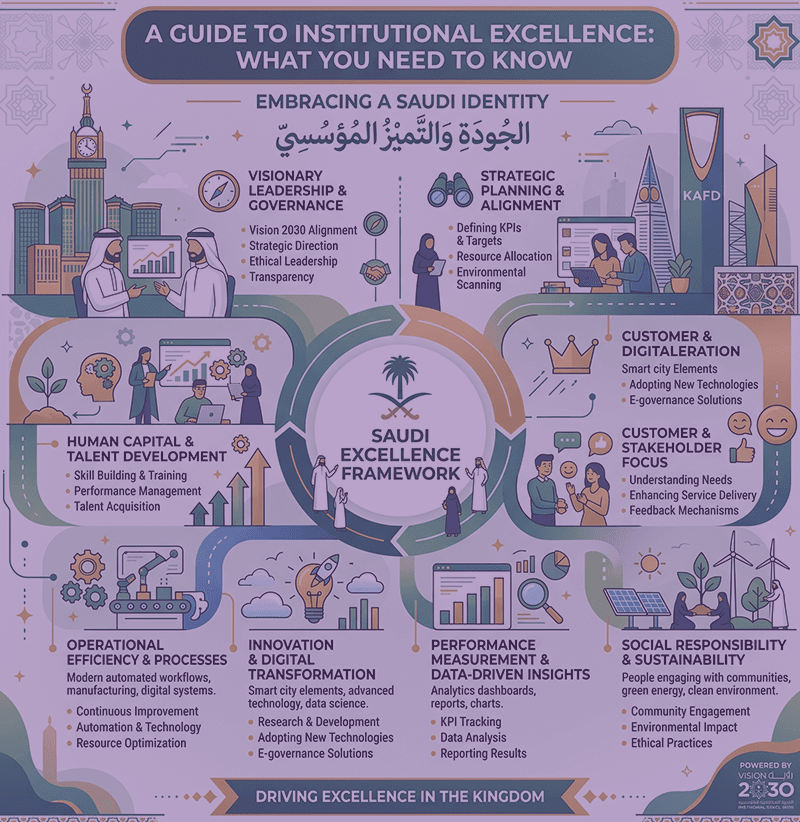
Attaining this level of distinction is far from simple. It demands the precise execution of practical, actionable steps that start at the apex of the administrative pyramid and reflect across all daily transactions:
- Formulating a Clear Strategic Vision:The journey begins by establishing SMART, flexible, and accessible goals for every individual in the organization, translating ambitious visions into measurable, data-driven performance metrics.
- Investing in and Developing Human Capital:Plans will fail unless you actively harness and sharpen the skills of your workforce—professionals of both genders—through continuous training.
- Automating Operational Process Engineering:True distinction means stripping away bureaucracy and complex, paper-heavy workflows to design agile procedures powered by modern technology.
- Cultivating a Culture of Continuous Evaluation and Improvement:Relying on transparency and robust governance ensures performance is audited periodically. This allows teams to address operational gaps flexibly, adapting smoothly to sudden shifts in the labor market.
Benefits of Implementing Organizational Excellence Criteria in the Corporate Sector:
Investing in a culture of corporate distinction yields tangible benefits that translate directly into financial performance and stability:
- It significantly lowers production and operational costs by eliminating redundant steps and unnecessary bottlenecks.
- It builds a powerful corporate reputation, positioning your enterprise as the premier choice for big-ticket business-to-business B2B deals.
- Work environments that embrace these standards become highly attractive to premium talent, driving the employee turnover rate down near zero.
- It instills a level of organizational resilience that cushions the company against unexpected economic crises, securing a steady flow of profits and returns.
How to Measure Your Company's Success:

Evaluating the success of your framework does not rely on vague impressions or emotional feedback. Instead, decision-makers measure Organizational Excellence through sharp, quantifiable key performance indicators:
| Metric | Strategic Value |
|---|---|
| Customer Satisfaction & Loyalty Index | Evaluates the quality of solutions provided to partners and your ability to meet expectations. |
| Return on Administrative Investment (ROAI) | Measures how administrative and technical updates increase net profits while cutting expenses. |
| Overall Process Efficiency Rate | Calculates the time and effort spent to deliver high-quality outputs at the lowest operational cost. |
| Governance & Risk Maturity Ratio | Ensures strict compliance with legal and ethical standards, helping the enterprise avert crises. |
The Journey of Development: Practical Steps Forward:
If your goal is to elevate your enterprise to entirely new tiers of efficiency, implementing Organizational Excellence requires a well-ordered, systematic roadmap:
- Comprehensive Self-Assessment: Conduct a transparent audit to map out the current gaps between your actual day-to-day performance and your target benchmarks.
- Formulating the Excellence Strategy: Establish clear, transparent, and actionable targets tailored to all teams, encompassing professionals of both genders.
- Training and Qualification: Channel resources into sharpening the capabilities of your human capital, ensuring their skill sets align with the newly adopted culture of distinction.
- Continuous Monitoring and Optimization: Deploy live digital dashboards to keep a close eye on operational workflows and update internal mechanisms with absolute agility.
Realistic Challenges Facing Corporate Distinction:
Despite the immense returns this ecosystem promises, deploying Organizational Excellence across the corporate sector comes with its own set of challenges. Most hurdles begin with internal resistance to change; many employees and managers naturally cling to familiar, traditional methods out of a fear of modern digital tools or stepping outside their comfort zones.
This challenge worsens when there is a lack of genuine commitment and decisive support from executive leadership. Without top-down enforcement, development plans risk turning into empty slogans that never manifest on the ground.
Furthermore, a shortage of qualified talent capable of understanding complex process re-engineering—coupled with poor interdepartmental coordination—can create isolated operational silos within a single organization.
How Corporate Distinction Cuts Hidden Costs:
Enterprises that embed these standards secure major financial victories by targeting invisible financial drain. The system actively slashes hidden costs through:
- Eradicating operational waste by deleting duplicated tasks and bureaucratic steps.
- Automating workflows and relying on tech solutions, which sharply lowers human error rates and preserves budgets.
- Distributing tasks and responsibilities based on hard data, preventing resource hoarding in specific departments.
- Providing a fair, motivating workspace that retains high performers, shielding the business from the steep costs of constant recruitment cycles.
Through these measures, the framework shifts from a flexible administrative philosophy into a decisive financial tool. It ensures that every single Saudi Riyal in your budget is funneled directly toward development, expansion, and maximizing net profits.
Conclusion:
The commercial landscape of 2026 proves that Organizational Excellence is no longer an optional luxury; it is the ultimate shield protecting your business from operational chaos and market volatility. Transitioning from a reactive, firefighting mindset to proactive leadership ensures sustained financial growth and internal stability that remains untouched—no matter how intense market competition gets.
Key Takeaway Checklist:
- A proactive, comprehensive methodology that aligns with Saudi Arabia's Vision 2030 to deliver sustainable value.
- Clear strategic vision, human capital empowerment, process automation, and robust governance.
- Elimination of operational waste, measurable cost reduction, high talent retention, and optimized workflows.
- Continuous auditing via customer loyalty indexes, ROAI, process efficiency rates, and calculated risk management.
Overcoming these initial structural and cultural hurdles is the single smartest investment you can make to guide your budget toward true corporate expansion.
Do not leave the future of your company to chance. Reach out to the corporate consultants at Saee today to construct a powerful, market-leading ecosystem.