
How Does Governance System Contribute to Achieving Digital Transformation within Vision 2030?
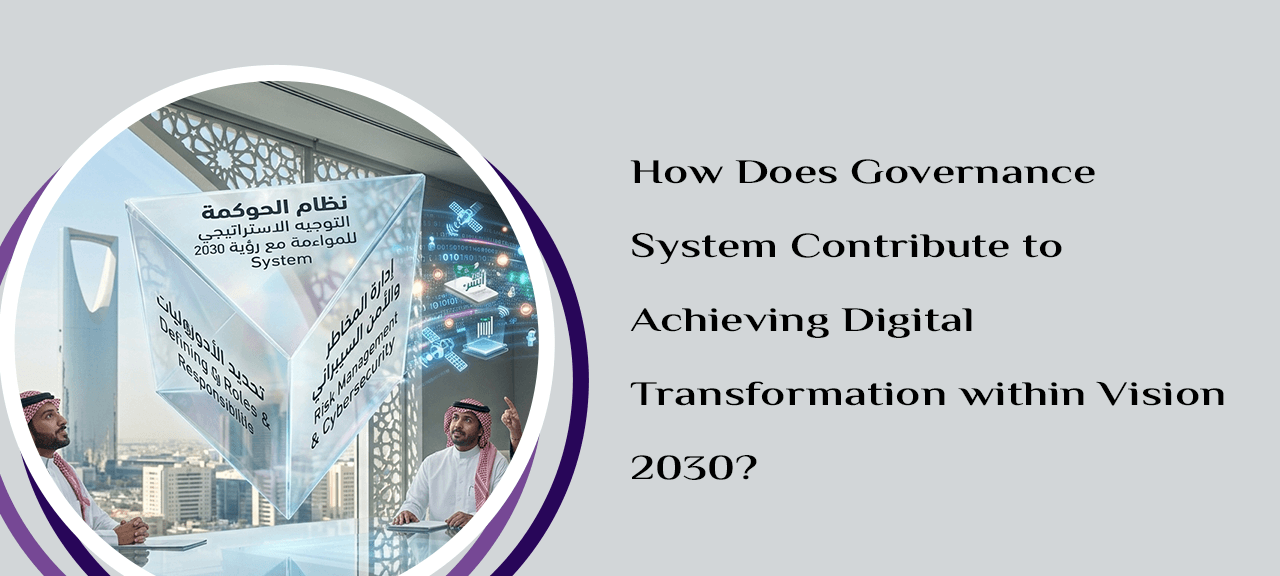
A car with no brakes… that is the true destiny of your company!
Unfortunately, this is the most accurate description for any enterprise racing ahead today to adopt modern technology, automation, and artificial intelligence without a controlling blueprint. Rushing to align with Saudi Arabia's Vision 2030 is highly commendable, but technology deployed without conscious administration turns into a costly chaos that threatens your business stability.
This is where you must pause and understand a structured Governance System. It represents the precise brakes that allow your car to accelerate at maximum speed, but with absolute safety. All the information you need on this subject is laid out in our article today.
What is a Governance System in Digital Transformation?

Governance in digital transformation means establishing clear rules, policies, and responsibilities that regulate how digital decisions are made within an institution. It defines who owns the decision, who executes it, who reviews it, how results are measured, and what benchmarks must be followed when developing services, managing data, or launching technical projects.
In simpler terms.
A Governance System does not block innovation; instead, it provides a safe, organized pathway.
Rather than having each department operate in complete isolation, all divisions become connected under a single framework.
This ensures digital projects are not duplicated, budgets are not wasted, and tech investments never drift away from corporate goals or the strategic directives of Vision 2030.
Therefore, success is not about owning the latest software, but about how it is managed to serve your ultimate objective.
What is the Difference Between Digital Transformation and Digital Governance?
Digital transformation is the process of deploying technology to upgrade services, workflows, and business models. On the other hand, digital governance is the strategic framework that regulates this transformation and ensures it moves forward according to clear goals and measurable standards.

In other words, digital transformation answers: What do we want to change? Meanwhile, a Governance System answers: How do we ensure this change is executed correctly, safely, and efficiently? There is no conflict between the two concepts; they share an entirely complementary relationship. The stronger your governance, the more sustainable and effective your digital transformation becomes.
How Does a Governance System Drive Digital Transformation in Vision 2030?
The genuine value that governance injects into the Saudi market is ensuring that technical projects succeed without falling into administrative disorganization. This contribution is demonstrated through:
- Protecting Budgets and Directing Expenditures: A Governance System ensures corporate funds are never wasted on unnecessary software or redundant technology. Instead, it channels investments strictly toward digital tools that improve workflow and boost profitability.
- Accelerating the Transition to Smart Platforms: By defining every employee's role and specific responsibilities, it reduces operational confusion and helps the workforce adopt new digital systems quickly and smoothly.
- Ensuring Absolute Compliance with Saudi Regulations: The Kingdom continuously issues strict laws and regulatory requirements for digital transactions. Here, the Governance System steps in to guarantee your company completely complies with these local laws, shielding you from heavy financial penalties or legal disputes.
- Clarifying Accountability and Monitoring Performance: Governance provides transparent key performance indicators, giving management the power to track digital project progress accurately, isolate structural flaws, and fix them immediately.
- Enabling Data-Backed Executive Decisions: It organizes corporate data pipelines, granting you access to precise, real-time reports that support smart decisions to scale the business.
We cannot discuss successful technology without securing its core engine: the information and data your enterprise relies on.
Data Governance and Cybersecurity: Shielding Your Digital Assets
With complete corporate reliance on cloud ecosystems and the internet, data has become the most valuable asset for any enterprise. Here, a structured Governance System serves as the protective umbrella that secures these assets by establishing clear policies for:
- Data classification and tiered access permissions.
- Strict compliance with national cybersecurity standards.
- Maintaining information quality and data precision.
- Protecting highly sensitive and proprietary information.
- Guaranteeing adherence to local regulatory frameworks.
Benefits of Implementing Digital Governance in Saudi Enterprises
When companies successfully merge technology with disciplined administration, they realize immediate rewards that lock down their long-term growth:

- Attracting Premium Investments: Committing to a strict Governance System reflects your company's absolute professionalism and transparency. This attracts both local and foreign investments, in perfect alignment with Vision 2030 targets.
- Agile Executive Maneuvering: It gives leadership the capacity to make rapid, numbers-driven decisions to navigate sudden market fluctuations.
- Sustained Operational Efficiency: Governance guarantees that digital frameworks operate at high performance over long horizons.
- Cost Optimization: It helps uncover unnecessary overhead expenses and cancels duplicated tech initiatives, saving the corporate budget.
- Advanced Threat Mitigation: It secures all company and partner information, lowering the risks of cyberattacks or data breaches.
Roadmap: Step-by-Step Governance Deployment:
Implementing governance does not mean adding complex, bureaucratic layers of administration. Instead, it is about building a transparent workflow that helps everyone make better decisions. You can deploy a Governance System through these structured phases:
1. Strategic Alignment
Define your digital transformation objectives clearly and bind them directly to the ultimate strategy of the institution.
2. Committee Formation
Establish a specialized internal committee or partner with an expert firm dedicated entirely to digital governance.
3. Role Delegation
Distribute clear roles, boundaries, and operational responsibilities between technical teams and operational departments.
4. Policy Drafting
Formulate transparent policies governing data management, information security, tech procurement, and the end-user experience.
5. KPI Integration
Adopt sharp key performance indicators to measure the actual operational and financial impact of every active digital project.
6. Iterative Review
Audit ongoing projects periodically and update internal governance policies whenever market or regulatory shifts demand it.
7. Workforce Empowerment
Train internal teams to operate seamlessly within the governance framework without slowing down the speed of creative innovation.
Key Challenges Facing Digital Governance
Despite its immense value, implementing a Governance System faces distinct hurdles, especially in institutions accustomed to traditional manual workflows or isolated decision-making:
- Friction and resistance to change from some internal teams.
- Weak awareness regarding the role of governance, with staff viewing it as an administrative burden.
- Scattered, unorganized data distributed across siloed departments.
- Overlapping responsibilities between technical IT divisions and operational business units.
- An over-emphasis on launching digital services rapidly while neglecting long-term quality and sustainability.
To overcome these roadblocks, governance must be presented as an enablement tool rather than a strict monitoring mechanism. Employees need to understand that a structured system clarifies their daily duties, shields the firm from critical errors, and maximizes the success rate of their digital projects.
Conclusion:
Sprinting blindly toward modern tech adoption without an established Governance System is exactly like driving a high-speed car with no brakes. Speed alone never guarantees you will reach your destination safely; organization, structure, and security are the actual foundations of corporate growth in the Saudi market under Vision 2030.
Strategic Summary:
- Governance does not restrict creative innovation; it protects it from internal chaos and directs your procurement budget toward tech tools that actually expand profit margins.
- Data governance and cybersecurity serve as an elite defensive shield for your company and client data, ensuring absolute compliance with Saudi legislative bodies.
- Corporate success begins by cultivating a modern digital mindset among your workforce, positioning governance as an asset that simplifies tasks and drives data-backed decisions.
Do not leave the future of your enterprise to administrative disorder and unchecked expenses. Take control and implement your Governance System today. To build a highly resilient, legally compliant, and market-leading corporate ecosystem, reach out to the professional organizational consultants at Saee now.